
What is a Tablet?
A tablet is the versatile “in-between” buddy that bridges the gap between the raw power of your PC and the constant connectivity of your smartphone. For students and professionals in 2026, it’s more than just a consumption device. It’s a powerful tool for note-taking, creative design, video calls, and, yes, winding down with your favorite shows.
But with so many options, how do you choose? It’s about far more than just portability. You need the right tool that fits seamlessly into your workflow, campus life, or creative process. Based on experience testing and research, here are the vital factors we considered to help you find your perfect match.
Before we get into the topic we should know what to look for in your average tablet.
Best Tablets For 2026 Buying Guide

Size and Weight
Tablets are designed to be mobile and because of this size and weight are important. After all, mostly you’re gonna be holding it for quite some time irrespective of the purpose. Therefore thickness is a key point to consider when making the purchase.
The Operating System (OS): Your Digital Ecosystem
This is your first and most crucial decision. The OS dictates the apps you can run, the accessories you can use, and how the device feels. The gold standard for app optimization, smooth performance, and long-term software support is the iOS. If you’re deep into creative apps like Procreate or Final Cut Pro, or value a seamless handoff with an iPhone/Mac, this is your ecosystem. The Apple Pencil experience is often considered the best for note-taking and drawing. Android is the champion of customization and flexibility.
Often offers better value for money, expandable storage via microSD cards, and a more open file system. Ideal if you prefer to tweak your device’s look and feel or want deeper integration with Google services and Windows PCs. Windows is the true laptop replacement. Runs full desktop applications like Microsoft Office, Adobe Suite, and even specialized engineering software. If you need one device to do absolutely everything a laptop can, a Windows tablet is the only choice.
Performance & Use Case: Matching Power to Purpose
For Students & Note-Takers, focus on battery life, a great stylus (like Apple Pencil or S Pen), and durable hardware. A mid-range processor is often more than enough for lectures, PDFs, and web research. For Creative Professionals & Designers, prioritize a high-performance chip (Apple M-series, Snapdragon 8-series), a stunning, color-accurate display, and best-in-class stylus support. Storage speed for large files is also key. For Office Workers & Hybrid Use, look for a balance of performance for video calls, multitasking capability, and compatibility with your company’s software. Keyboard accessory quality is paramount here.
Display & Form Factor: Your Window to Work
11-inch screens offer the best balance of portability and usable workspace. 12.9-inch or larger models are incredible for split-screen multitasking and digital art but are less lap-friendly. An LCD screen is fine for most tasks. OLED offers perfect blacks and is worth it for media consumption and creative work. A 120Hz ProMotion or similar high refresh rate makes scrolling and drawing feel buttery smooth, a luxury that becomes a necessity once you experience it. A more square aspect ratio (like 4:3 on iPads) is better for documents and web pages. A wider aspect ratio (like 16:10 on many Android tablets) is better for watching movies.
The Accessory Ecosystem: Beyond the Glass
Is the keyboard comfortable for long typing sessions? Does it have a stable kickstand? This accessory is what turns your tablet into a laptop substitute. How does it charge? What’s the latency and pressure sensitivity like? This is non-negotiable for students and artists. Do you need a headphone jack? Will a single USB-C port be enough, or do you need the expandability of multiple ports (like on a Samsung Tab S9 or Surface Pro)? 5G cellular connectivity is a major convenience upgrade for always-online work.
Battery Life & Future-Proofing
Look for a device that promises 10+ hours of real-world use. There’s nothing worse than your device dying during a late-night study session or a cross-country flight. One of Apple’s biggest strengths is 5+ years of OS updates. This protects your investment. Check the update policy for Android and Windows devices carefully.
The best tablet for 2026 isn’t the one with the highest specs. It’s the one that disappears into your workflow, empowering you without getting in the way. It should feel like a natural extension of your intent, whether you’re sketching an idea, compiling research, or presenting in a meeting. Alright! Now that’s out of the way and we are well informed on what to look for before the purchase, Lets jump to our suggestions for the best tablets for 2026.
Samsung Galaxy Tab A9+
- 11″ screen with refresh rate of up to 90Hz
- Quad speakers powered by Dolby Atmos
- 64GB/128GB memory and 4 GB RAM
- 50 MP camera
- Qualcomm ARM Cortex A53 CPU
- 1920 x 1200 pixels resolution
After using the Galaxy Tab A6 as my main tablet for a long period, I can confidently say the A series carves out a very specific, useful niche. It’s not trying to be a laptop replacement or a creative powerhouse. Instead, it excels as a brilliantly focused, budget-friendly entertainment and light-duty companion that gets the fundamentals incredibly right. The 11-inch, 90Hz display is the star. Scrolling through social media, news apps, and web pages feels noticeably smoother than on a standard 60Hz screen. While it’s not an OLED panel, colors are vibrant and brightness is perfectly adequate for indoor use. Paired with the quad speakers tuned by Dolby Atmos, this tablet delivers a fantastic audio-visual experience for the price. It’s lightweight and thin, making it easy to hold for long periods while reading or watching videos in bed or on the couch. It doesn’t feel like a chore to use.

The 4GB of RAM is the defining boundary. You can use Samsung’s excellent split-screen feature to, for example, have a lecture video on one side and your notes app on the other. However, if you try to rapidly switch between more than 3-4 modern apps, you’ll encounter reloads. It’s designed for focused 2-app multitasking, not juggling a dozen. A standout UX feature. In the settings, you can set a maximum charge limit (like 85%) and turn off fast charging. If you often use it plugged in on your desk or bedside, this dramatically helps preserve long-term battery health. The 64GB base storage fills up quickly with apps and system files. Thankfully, the MicroSD card slot (supporting up to 1TB) is a lifesaver. It’s not for demanding 3D gaming or heavy, sustained multitasking. The 4GB RAM is its main bottleneck. But then again it’s a tab not a gaming PC.
Apple iPad 11-inch
- 11-Inch edge-to-edge Liquid Retina display with Promotion
- A16 chip
- Storage starts at 128GB up to 512GB
- Wi-Fi 6
- 2360-by-1640-pixel resolution
- 12MP Wide back camera with True Tone flash
Even the majority of the android fans accept the quality of the iPad to be superior. Based on its specs and positioning, the Apple iPad provides a user experience centered on delivering pro-level performance in the most accessible iPad form factor. It’s the “gateway” to the full Apple ecosystem, offering a taste of high-end speed without the flagship price, though with some clear strategic compromises. Coming from any older base-model iPad or Android tablet, the A16 Bionic chip is immediately noticeable. Apps launch instantly, web pages with dozens of tabs remain snappy, and moderately complex photo edits in Lightroom or video cuts in iMovie are handled without breaking a sweat. For the vast majority of users, students, note-takers, content consumers, and casual creators
The UX is defined by iPadOS’s smoothness and consistency. Gestures feel natural, animations are fluid, and the integration between Apple’s own apps (Safari, Files, Notes) is seamless. The all-day battery life is reliable. The 11-inch screen is bright, sharp, and color-accurate. It’s a joy for reading, watching movies, and browsing. True Tone, which adjusts the white balance to your environment, makes long reading sessions easier on the eyes. The most noticeable difference between this and an iPad Pro is the standard 60Hz refresh rate. If you’ve never used a 120Hz ProMotion display, you won’t miss it. However, side-by-side, ProMotion feels buttery smooth, making this iPad’s scrolling and pencil input feel very good, but not elite.

The ability to add precise note-taking and drawing transforms this from a consumption device into a creative tool. For students, marking up PDFs or sketching ideas is a core part of the iPad appeal. The Magic Keyboard Folio Compatibility is a game-changer for productivity. While expensive, it turns the iPad into a genuine laptop substitute for writing papers, emails, and light work. The Touch ID in the top button provides fast, secure unlocking and payments. The flip side is to unlock its full potential, you must invest in expensive first-party accessories (Pencil, Keyboard), which can significantly increase the total cost.
The Apple iPad A16 is the smartest choice for most people. It delivers 90% of the premium iPad Pro experience for a much lower price. Its user experience is defined by effortless performance, a polished operating system, and the incredible versatility offered by its accessory ecosystem. The compromises (like the 60Hz screen) are calculated and sensible to reach its attractive price point. If you want a powerful, versatile tablet that will last for many years, this is the benchmark against which all others are measured.
Wacom Intuos Pro Medium
- Windows 10, Mac OS 13 or later
- Pro Pen 3 with 8192 pressure levels, tilt support & lag-free tracking
- 10 customizable tablet ExpressKeys & 2 mechanical dials
- 16:9 format, Bluetooth, USB-C to USB-A, USB-C to USB-C
Based on its specifications and the context from professional user reviews, the Wacom Intuos Pro Medium Edition isn’t just a drawing tablet; it’s a precision-engineered control surface for the serious digital artist and creative professional. Its user experience is defined by an uncompromising focus on workflow efficiency, natural pen feel, and studio-grade reliability, making it a tool that aims to disappear and let your creativity flow. There is a reason why everyone keeps recommending this for pro work. Using the Intuos Pro feels fundamentally different from using a consumer tablet. It’s not a touchscreen device you look at. it’s a tactile, responsive surface you command with a pen while looking at your computer monitor.
The battery-free Pro Pen 3 is where Wacom’s decades of expertise shine. It offers exceptional precision, virtually lag-free tracking, and 8192 levels of pressure sensitivity. The initial resistance and texture of the standard nib on the tablet’s surface provide a drawing feel remarkably close to paper
his isn’t a one-size-fits-all pen. You can adjust its weight balance and swap between three grip styles (Slim, Standard, Flared). This level of ergonomic customization is a professional luxury that can reduce fatigue during marathon illustration or 3D sculpting sessions. he 10 programmable ExpressKeys and 2 mechanical touch rings are not an afterthought; they are core to the UX. Positioned along the top edge, they are always within reach of your non-drawing hand. You can map your most-used shortcuts (undo, brush size, alt/ctrl, etc.), and the rings provide intuitive control for zooming, scrolling timelines in video editors, or rotating canvases.

This keeps your workflow on the keyboard to a minimum. You can connect via the included USB-C cable for guaranteed zero-latency performance, or use Bluetooth to pair with up to three devices. A note from users is that several windows 11 users report Bluetooth connectivity issues, while macOS users praise its stability. This is a crucial point of consideration.
Wacom’s drivers are powerful and deep, allowing immense customization for every supported application (like Photoshop, Illustrator, ZBrush, Blender). On the other hand, moving from mouse to pen tablet requires developing new muscle memory. Mastering the ExpressKeys adds another layer. You draw on the tablet while looking at your computer screen. Some artists prefer the direct hand-eye connection of a display tablet (like a Wacom Cintiq), though many professionals prefer the ergonomics of an Intuos. If your livelihood or serious passion depends on digital creation, this is a benchmark device worth the investment. If your needs are more casual, its advanced features and cost will likely be overkill.
XPPen Drawing Tablet
- Windows 10/8/7 and Mac OS X 10.10
- Tilt Function up to 60 degrees
- High Color Gamut
- 1920×1080 with pressure sensitivity of 8192 Levels
The XPPen Artist13.3 Pro is a high-value entry into the world of display drawing tablets. It delivers the coveted experience of “drawing directly on the screen” with solid performance and a rich feature set, making it an excellent choice for artists and designers stepping up from a basic pen tablet who are also on a budget. The main appeal is the direct, intuitive connection of putting pen to screen. The fully laminated display means the glass and screen are bonded, so the pen tip feels like it’s right on your artwork with minimal “parallax” (gap). The screen surface has a bit of tooth, offering more friction than slick glass for a pencil-on-paper feel. For workflow, the 8 customizable shortcut keys and red dial on the side are incredibly handy. Comes with a functional adjustable stand, a glove, and spare pen nibs right in the box.
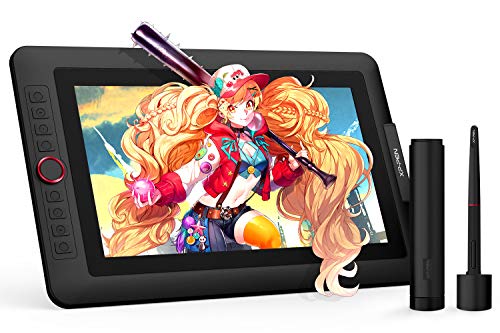
The 1920×1080 (Full HD) resolution is good, but not as sharp as 2K or 4K screens on more expensive models. Like we said, a good budget choice. Offers the core display tablet experience for a fraction of the cost of high-end brands. Best suited if you work primarily at a fixed desk with a computer. The XPPen Artist13.3 Pro is a gateway to professional digital art tools. It successfully delivers the immersive experience of a display tablet with few compromises for its price. If your goal is to draw directly on your artwork with vibrant colors and handy shortcuts, it represents outstanding value and a fantastic next step in your creative journey.
Amazon Fire HD 10
- 10.1″ 1080p Full HD display
- 3 GB RAM
- 13-hour battery, 32 or 64 GB of storage
- Up to 1 TB expandable storage
- 5 MP front cam
The Amazon Fire HD 10 delivers a focused user experience centered on effortless, affordable media consumption within the Amazon ecosystem. It’s a “relaxation-first” tablet that excels at streaming, reading, and light browsing, but makes clear trade-offs to hit its low price point. The 10.1-inch Full HD screen is the star for the price. Colors pop, making streaming movies on Prime Video, Disney+, or Netflix enjoyable. The tablet runs on Fire OS, a customized version of Android. The main UX consequence is the Amazon Appstore. You’ll find most major streaming, social, and game apps, but many popular Google apps (like Chrome, Gmail, Google Maps) or niche applications are unavailable. This can feel limiting if you’re used to a full Android or iPadOS device.
Amazon claims it’s much more durable than competitors in drop tests, which aligns with its “pick up and go” vibe for use around the house. New AI-powered features like webpage summarization and email polishing are neat additions. The optional Made for Amazon Stylus Pen (sold separately) with 4,096 pressure levels works well for basic note-taking in supported apps, adding unexpected versatility. Perfect if you’re deep into Kindle, Prime Video, Audible, and Alexa. Best for streaming and light apps, but not for demanding games or heavy multitasking. It’s a fantastic first tablet for kids (with Amazon Kids+) or a secondary, worry-free screen for the living room or bedroom. The Amazon Fire HD 10 nails its mission: to be the most comfortable, no-fuss portal into Amazon’s world of entertainment. It asks you to accept its limits in exchange for a simple, durable, and highly affordable way to relax.

Satisfied with our suggestions for the Best Tablets For 2026? What are your thoughts on the list? let us know in the comments below.
About the Author


